
Top real estate developers use 3D renderings to secure municipal approvals, align stakeholders, and maximize pre-sales velocity by converting complex architectural data into undeniable visual proof. By presenting photorealistic, high-fidelity visualizations before breaking ground, developers eliminate ambiguity for planning committees, de-risk investments for capital partners, and compress the sales cycle through high-impact pre-marketing.
In today’s capital-intensive and highly regulated property market, high-fidelity real estate 3D rendering is no longer a luxury. It is a strategic necessity for project entitlement and commercial viability. According to industry data from the National Association of Realtors, properties backed by premium visual marketing assets sell faster and command higher valuation premiums than those relying solely on 2D drafts. Despite this overwhelming evidence, many development firms still treat visualization as an afterthought, underestimating its power to navigate bureaucratic hurdles and unlock capital.
This comprehensive guide analyzes the exact mechanisms through which tier-1 developers leverage architectural visualization. We will break down the specific technical assets required at each stage of the development pipeline, how to deploy them efficiently to win over planning boards, and the critical execution mistakes that can derail a project’s positioning.
Whether you are navigating the entitlement process for a boutique residential project or driving pre-sales for a 500-unit mixed-use commercial tower, this strategic framework delivers the clear, actionable insights needed to sell your vision long before the first brick is laid.
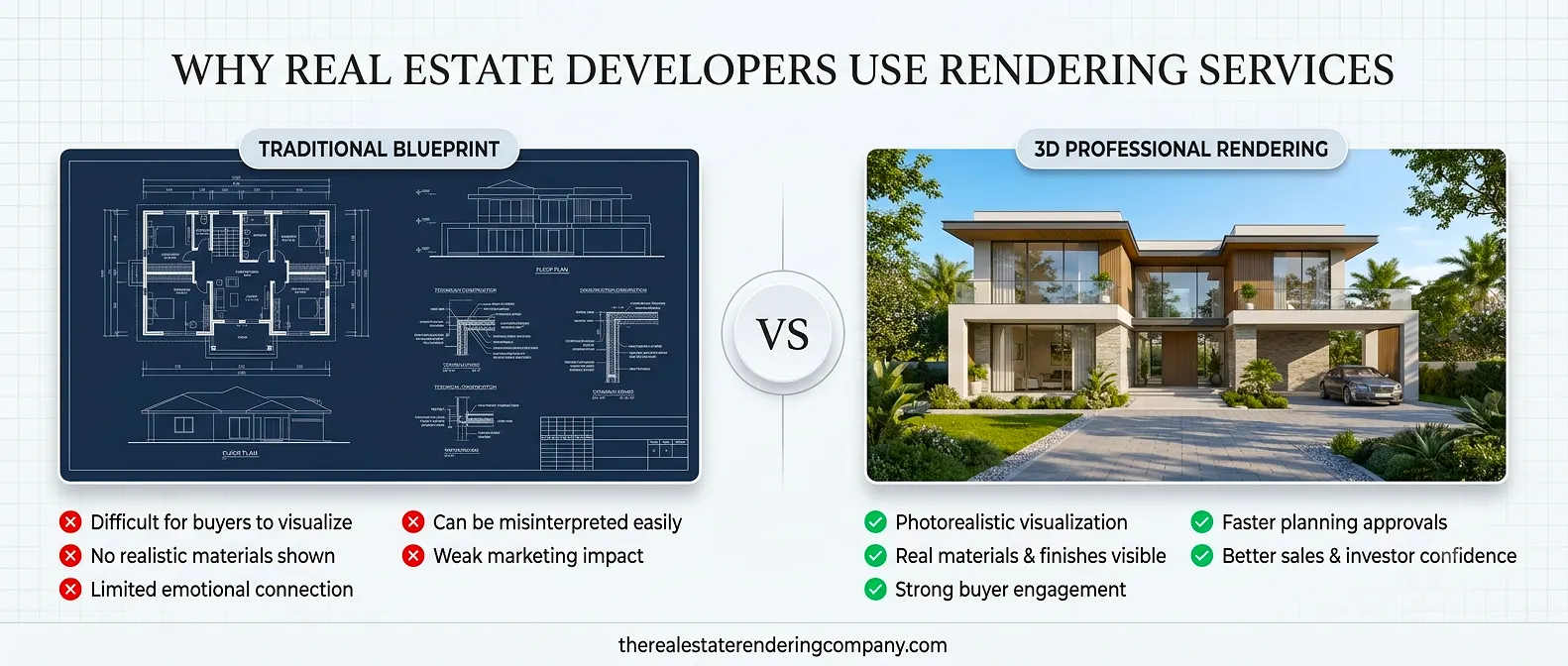
Accelerating the Entitlement Process and Municipal Approvals
Navigating the municipal entitlement pipeline is one of the most volatile phases of asset development. Architectural blueprints and technical grading plans, while necessary for engineering, often fail to communicate a project’s contextual harmony to non-technical stakeholders. By translating raw CAD and BIM data into high-fidelity 3D renderings, development firms provide zoning boards, city councils, and local planning committees with unmistakable visual evidence of a project’s real-world impact.
Presenting hyper-realistic spatial visualizations before breaking ground directly mitigates the friction that typically stalls approvals. It allows developers to proactively address common municipal concerns regarding setback requirements, shadow projections, traffic integration, and neighborhood aesthetic alignment. Instead of debating abstract concepts during public comment periods, developers can present undeniable visual facts, significantly reducing the timeline for variances and conditional use permits.
Quick Answer
How do 3D renderings accelerate project entitlements? > Top developers leverage photorealistic 3D visualization to de-risk the municipal approval process. By delivering clear, contextually accurate visual representations of an unbuilt asset, firms eliminate ambiguity for planning boards, minimize public pushback during town halls, and prevent the costly design iterations or zoning delays that erode project IRR.
87%
of buyers say visuals heavily influence their purchase decision
3×
faster pre-sales reported by developers using 3D renderings
40%
fewer design revisions during construction with pre-build visualization
$0
physical show home required when 3D virtual tours are used
What Are Photorealistic 3D Visualization Renderings?
Photorealistic 3D visualization renderings are computer-generated images that convert architectural plans, blueprints, and digital models into lifelike, accurate visual representations of a property before construction begins. Utilizing advanced lighting, material textures, and accurate spatial geometry, these high-fidelity visual assets allow real estate professionals to showcase unbuilt developments with complete stylistic and environmental accuracy.
These services cover a broad range of deliverables, including:
- Exterior 3D renderings – photorealistic views of a building’s facade, landscaping, and street context
- Interior 3D renderings – richly detailed depictions of rooms, finishes, and furniture arrangements
- Aerial and bird’s-eye renderings – overhead perspectives showing the project within its wider environment
- 360° virtual tours – interactive panoramic views that allow buyers to “walk through” a property online
- Animated fly-through videos – cinematic sequences that guide viewers through the development
- 2D and 3D floor plans – clear, scaled layouts that communicate spatial relationships
Together, these tools allow developers to present projects professionally and persuasively – long before the physical structure exists.
The Top Reasons Why Real Estate Developers Use Photorealistic 3D Renderings
Understanding why real estate developers use Photorealistic 3D Renderings requires looking at the full lifecycle of a development – from land acquisition through planning, marketing, sales, and handover. Rendering services deliver measurable value at every stage.
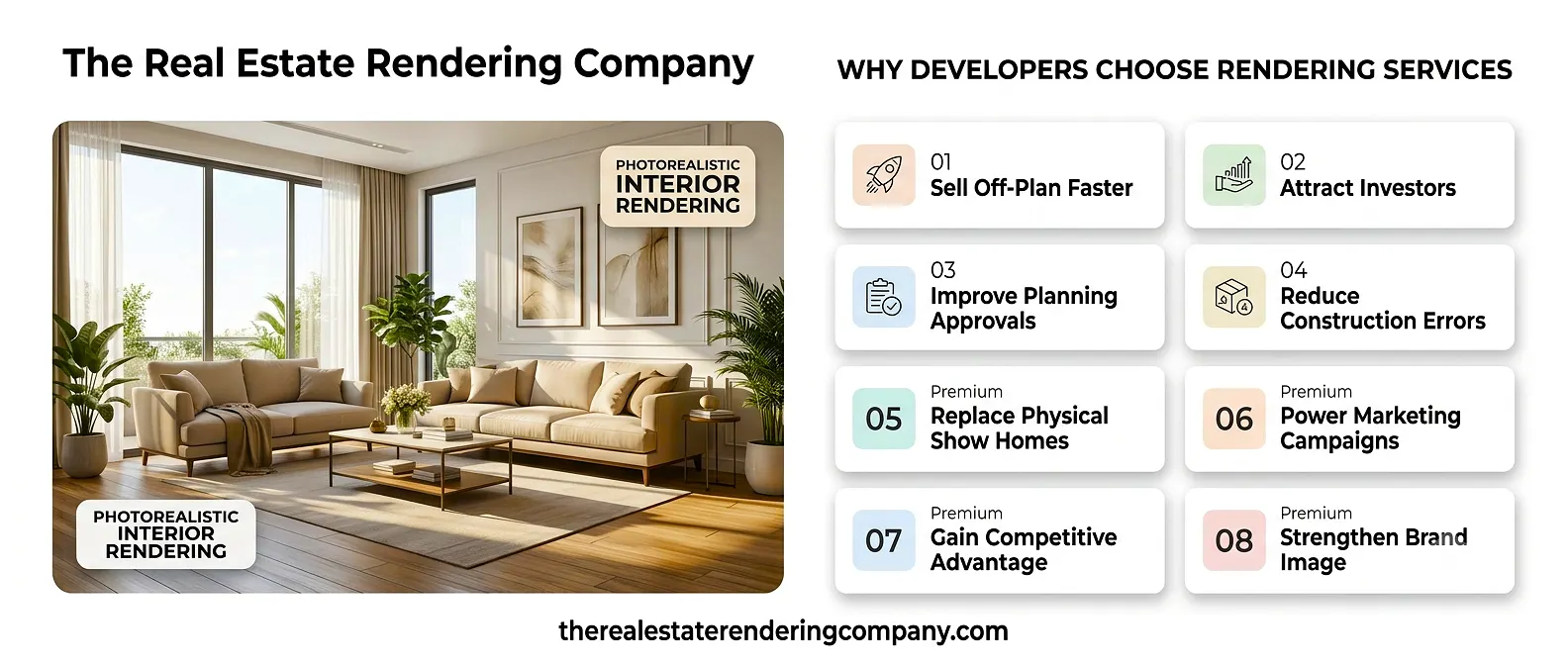
1. Selling Off-Plan Properties with Confidence
Perhaps the most commercially significant reason why real estate developers use rendering services is the ability to sell units before construction begins. Off-plan sales generate critical pre-construction revenue that funds the project, reduces financial risk, and demonstrates market demand to lenders and investors.
Without compelling visuals, asking someone to commit hundreds of thousands – or even millions – of dollars to something that does not yet exist is an enormous ask. Photorealistic renderings change that dynamic entirely. They give buyers a vivid, emotionally resonant preview of what they are purchasing, making the decision feel concrete rather than speculative.
Developer Insight
Developers who launch sales campaigns with photorealistic 3D renderings and virtual tours consistently report that off-plan reservations convert at significantly higher rates than those using traditional 2D drawings or architectural sketches alone.
2. Attracting and Securing Investment
Real estate development is a capital-intensive business. Developers regularly present to institutional investors, private equity funds, family offices, and individual high-net-worth backers. In those presentations, the quality of visual materials directly influences the perceived professionalism and viability of a project.
A polished suite of photorealistic renderings, aerial views, and animated fly-throughs communicates far more than a set of plans ever could. It shows investors that the developer has a clear, fully-formed vision – and that they have invested in communicating it properly. That signals competence, reduces perceived risk, and makes funding conversations considerably more productive.
3. Winning Planning and Regulatory Approvals
Planning authorities, city councils, and neighborhood committees must evaluate how a proposed development will impact the existing built environment. Submitted planning applications that include photorealistic context renderings – showing the proposed building alongside existing streetscapes, landscaping, and neighboring properties – are demonstrably easier for decision-makers to assess.
According to guidance from the American Planning Association, clear visual representations of proposed developments help planning bodies make better-informed decisions while also reducing objections from the public, who can more easily understand what is being proposed when they can see it realistically depicted.
4. Identifying and Eliminating Design Errors Early
One of the most underappreciated reasons why real estate developers use rendering services is design validation. Creating a photorealistic 3D model forces a thorough review of the design before anything is built. Spatial inconsistencies, proportion issues, material clashes, lighting problems, and layout inefficiencies – all of which might go undetected in 2D drawings – become immediately obvious in a 3D render.
Identifying these issues at the design stage costs a fraction of what it costs to fix them during or after construction. Studies from the construction industry consistently show that each dollar spent on pre-construction design problem-solving saves between five and ten dollars in downstream corrections.
5. Building Powerful Marketing and Sales Materials
Real estate marketing today demands visual content at every touchpoint: websites, social media platforms, digital advertising, print brochures, sales center displays, and property portal listings. Renderings provide a library of high-quality, brand-consistent images that can be deployed across all of these channels.
Specifically, developers use renderings to:
- Create hero visuals for property websites and landing pages
- Populate social media feeds with aspirational imagery months before launch
- Produce print-ready brochures for sales centers and open events
- Run paid digital advertising campaigns with high-conversion imagery
- Generate press coverage with compelling visual assets
- Equip sales teams with printed and digital materials for buyer presentations
6. Replacing Expensive Physical Show Homes
Traditionally, developers built expensive show homes or show apartments to allow buyers to experience the quality and layout of a development firsthand. This approach involves significant cost – building, furnishing, maintaining, and staffing a show unit can easily run into hundreds of thousands of dollars.
High-quality interior renderings and 360° virtual tours can replace or significantly supplement physical show homes. Buyers can explore every room from their computer or phone, at any hour, from anywhere in the world. For internationally marketed luxury developments, this is particularly transformative.
7. Gaining a Competitive Advantage in a Crowded Market
In any active property market, multiple competing developments are vying for the attention of the same pool of buyers and investors. The developers who present their projects with the most compelling, professional visual storytelling consistently win a disproportionate share of that attention.
Using premium rendering services is therefore not just about presenting a single project well – it is a strategic differentiator that elevates a developer’s brand above competitors.
8. Supporting Brand Building and Developer Reputation
Every rendering produced is, in a sense, a statement about a developer’s standards, taste, and ambition. Consistently high-quality visual outputs across multiple projects build brand recognition and reinforce a reputation for excellence. That reputation, over time, becomes a self-reinforcing commercial advantage that attracts better buyers, better investors, and better collaborators.
Types of Photorealistic 3D Renderings Real Estate Developers Use
Not all rendering services serve the same purpose. Savvy developers match the right type of rendering to each specific need. Here is a comprehensive breakdown of the main options available:
| Rendering Type | Best Used For | Output Format | Ideal Stage |
|---|---|---|---|
| Exterior 3D Rendering | Showcasing building facade, landscaping, street presence | High-res static image | Marketing, planning |
| Interior 3D Rendering | Demonstrating finishes, layouts, mood, and lifestyle | High-res static image | Sales, brochures |
| Aerial / Bird’s Eye View | Showing site context, density, and surrounding amenities | High-res static image | Planning, investment |
| 360° Virtual Tour | Immersive online buyer experience; replacing show home | Interactive web embed | Online sales, global marketing |
| Animated Fly-Through | Cinematic storytelling; social media; investor decks | MP4 video | Launch events, digital ads |
| 2D Floor Plans | Spatial clarity; portal listings; print brochures | Vector / high-res image | Sales, listings |
| 3D Floor Plans | Buyers who struggle to read flat plans; premium brochures | High-res image | Sales, presentation |
You can explore the full range of professional options on the website homepage to find the right solution for your current project stage.
The ROI of High-Fidelity Photorealistic 3D Renderings: Cost vs. Value
A common question among developers – particularly those working on smaller projects – is whether the investment in professional rendering services delivers a meaningful return. The evidence strongly suggests that it does, often dramatically so.
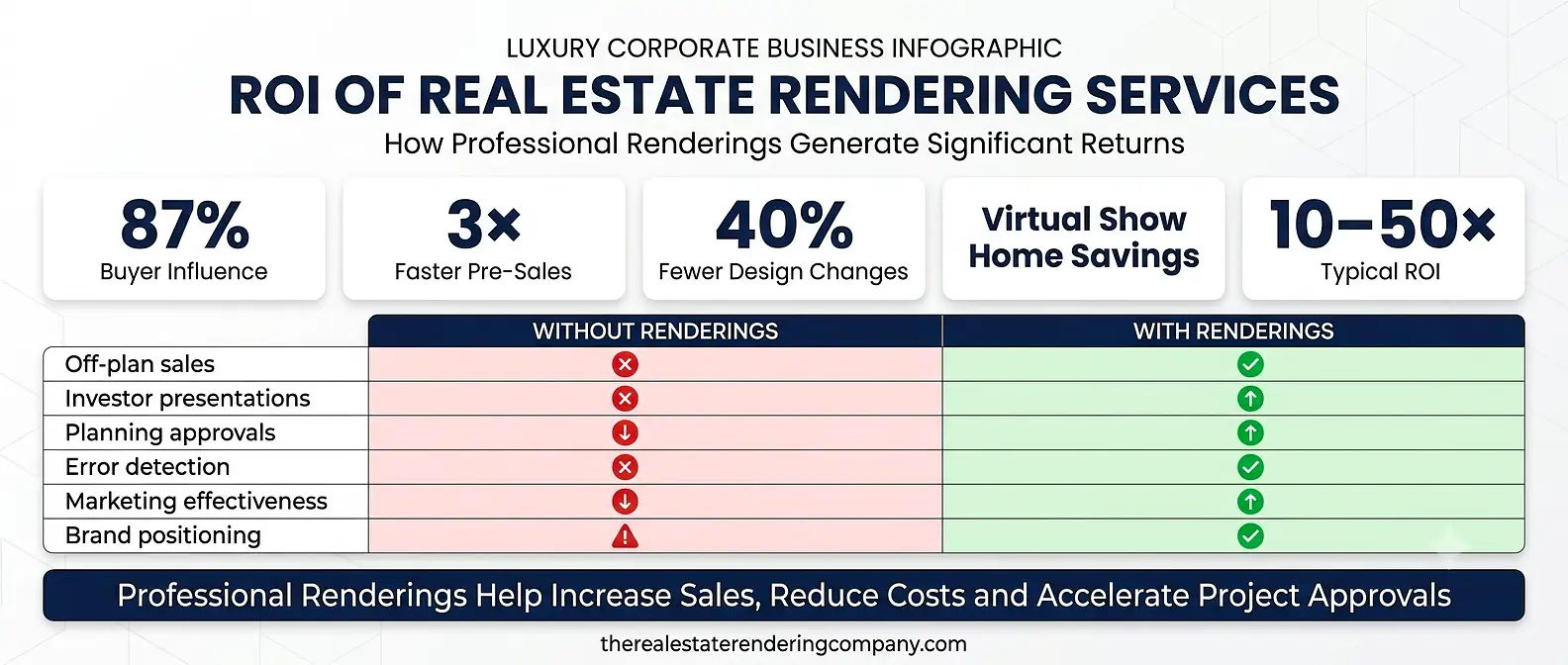
| Value Area | Without Renderings | With Renderings | Advantage |
|---|---|---|---|
| Off-Plan Sales Rate | Low — buyers hesitant | High — buyers confident | High Impact |
| Investor Presentations | Plans & sketches only | Photorealistic portfolio | High Impact |
| Planning Approval Speed | Slower; more objections | Faster; clearer proposals | Medium Impact |
| Design Error Catch Rate | Often found during build | Found at design stage | High Impact |
| Show Home Cost | $100k–$500k+ to build | Virtual tour alternative | Cost Saving |
| Marketing Content Volume | Limited; generic visuals | Full multi-channel library | Medium Impact |
| Brand Positioning | Average; forgettable | Premium; distinctive | High Impact |
For precise, project-specific pricing, visit the pricing page to explore packages tailored for every scale of development.
Key Insight
When you weigh the cost of professional renderings against the potential cost savings from faster pre-sales, avoided construction errors, and eliminated show home expenditure, rendering services routinely deliver a return of 10× to 50× on investment for mid-to-large development projects.
How the Real Estate Rendering Process Works
If you have not commissioned 3D renderings before, understanding the workflow helps set expectations and ensures the best possible outcome. The process is collaborative, iterative, and – with the right studio – straightforward.
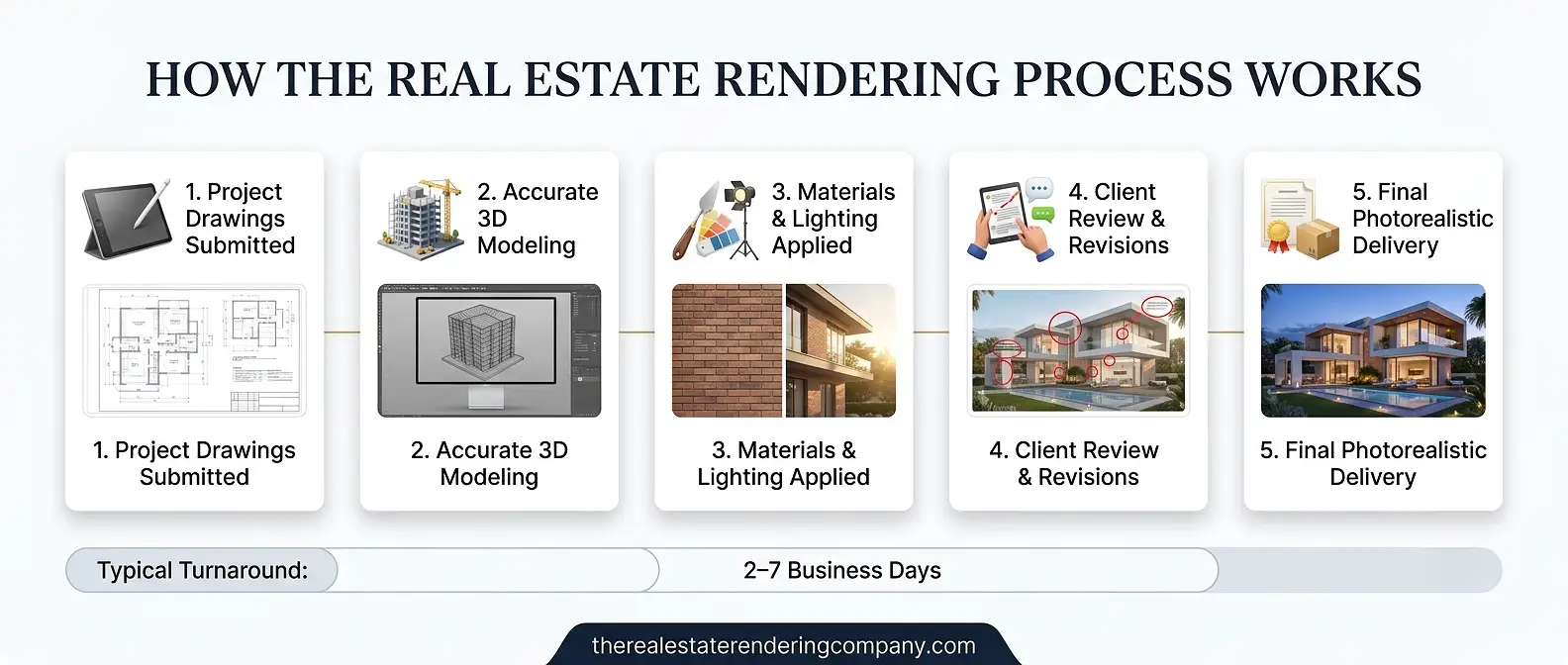
Project Brief & Asset Submission
You share your architectural drawings, CAD files, or concept sketches alongside a brief covering desired camera angles, time of day, mood, materials, and surrounding context.
3D Modeling
The studio builds an accurate three-dimensional digital model of the building and its immediate environment, including landscaping, street furniture, and neighboring structures.
Material & Lighting Application
Textures, materials, finishes, and lighting conditions are applied to the model. This stage is where the rendering begins to feel photorealistic, with accurate reflections, shadows, and atmospheric effects.
Draft Rendering & Client Review
An initial draft is produced and shared for your feedback. You can request adjustments to camera angles, materials, lighting, or any other element at this stage.
Final Production & Delivery
Following your approval, the final high-resolution rendering is produced and delivered in your required file formats – ready for immediate use across all marketing channels.
For a seamless experience from brief to delivery, the team at The Real Estate Rendering Company works with developers at every scale – from boutique residential projects to large commercial developments.
Common Mistakes Real Estate Developers Make with 3D Architectural Renderings
Even experienced developers sometimes approach rendering projects in ways that limit the value they receive. Avoiding these common pitfalls will help you get far more from your investment.
Mistake 1: Commissioning Renderings Too Late in the Process
Many developers treat rendering as a marketing afterthought – something to commission once construction is already underway. In reality, the greatest value comes from having renderings ready at or before the planning stage. Earlier renderings mean earlier sales, earlier investment conversations, and earlier design validation.
Mistake 2: Choosing on Price Alone
The real estate market is not one where a buyer’s first visual impression can afford to be mediocre. Choosing the cheapest available rendering service over a premium, experienced studio is a false economy. Poor-quality visuals actively undermine buyer confidence and developer credibility. The rendering is often the first thing a potential buyer sees about your project – it sets the tone for everything that follows.
Mistake 3: Providing Insufficient Project Information
The quality of a rendering is directly proportional to the quality of the information provided to the rendering studio. Developers who submit incomplete or inconsistent drawings, vague material specifications, or unclear briefs inevitably receive renderings that require multiple costly revision rounds. Prepare thorough, detailed input materials before commissioning work.
Mistake 4: Using Renderings on Too Few Channels
A high-quality rendering is a versatile asset. Some developers commission excellent work and then use it only on a single platform – say, a website hero image – while leaving its potential completely untapped across social media, digital advertising, investor presentations, press materials, and sales center displays. Always plan a multi-channel distribution strategy for every rendering you commission.
Mistake 5: Neglecting Floor Plans
Buyers have an emotional response to exterior and interior renderings – but they use floor plans to make rational, spatial decisions about a purchase. Neglecting high-quality 2D and 3D floor plans leaves a critical gap in the buyer’s journey. Both should always be part of the rendering brief.
Expert Tips for Getting the Most from high-fidelity 3D architectural visualization
Beyond avoiding mistakes, there are several proactive strategies that consistently produce outstanding results for developers who use rendering services well.
Tip 1: Brief the Mood, Not Just the Architecture
Great renderings do not just show a building – they tell a story about the lifestyle it enables. When briefing your rendering studio, go beyond specifications. Describe the emotional feeling you want the images to evoke. Words like “warm and welcoming,” “sleek and aspirational,” or “connected to nature” give the rendering team vital creative direction that technical drawings alone cannot provide.
Tip 2: Plan Your Camera Angles Strategically
Think carefully about which views will be most compelling and commercially useful. A strong hero exterior shot from street level, an elevated aerial view showing the building in context, and one or two key interior scenes will typically cover your core marketing needs. Additional angles can be added for specific audiences – such as a rooftop terrace view for lifestyle marketing or an entrance lobby render for investor presentations.
Tip 3: Use Day and Twilight Versions
Requesting both a daytime and a twilight version of key exterior renderings doubles the versatility of your visual library. Daytime renders work well for print and formal presentations; twilight renders with warm internal lighting glowing through windows are dramatically effective on social media and digital advertising, where emotional impact drives engagement.
Tip 4: Align Renderings with Your Sales Funnel
Different buyers are at different stages of the decision journey. An aerial overview works best for top-of-funnel awareness marketing. Detailed interior renderings are most effective when a buyer is at the consideration stage. A 360° virtual tour or animated fly-through is the most persuasive tool when a buyer is close to committing. Plan your rendering brief to produce assets for every stage of the funnel, not just one.
Tip 5: Use Renderings to Support 2D and 3D Floor Plans
Pairing photorealistic renders with professionally produced floor plans from The 2D3D Floor Plan Company creates a more complete and compelling sales toolkit. Buyers who can both see the space and understand its layout are significantly more confident – and more likely to convert.
Pro Tip
Request your renderings in multiple aspect ratios from the start – landscape for websites and print, square or portrait for Instagram, and widescreen for video and presentation screens. This saves time and cost compared to reworking crops later.
Ready to Transform Your Real Estate Vision Into Reality?
The Real Estate Rendering Company provides photorealistic 3D renderings, architectural visualizations, floor plans, virtual tours, and marketing assets that help developers, architects, builders, and real estate professionals attract buyers, secure investors, and accelerate project approvals.
Frequently Asked Questions
Why do real estate developers use photorealistic renderings specifically for off-plan sales?
Off-plan properties are sold before they are built, which means buyers cannot physically visit or experience them. Photorealistic renderings bridge that gap by giving buyers a vivid, accurate preview of the completed development – covering exterior appearance, interior finishes, layouts, and the surrounding environment. This visual evidence dramatically reduces buyer hesitation and accelerates the decision-making process, enabling developers to generate pre-sale revenue that funds construction.
How much does a real estate 3D renderings typically cost?
Costs vary depending on the complexity of the project, the number of views required, the level of detail, and whether animation or interactive elements are included. Standard exterior renderings can start from a few hundred dollars, while full interior renders, virtual tours, or animated fly-throughs for larger projects may run into several thousand dollars. Visit the pricing page for specific, transparent package pricing.
Can rendering services replace a physical show home entirely?
In many cases, yes. High-quality interior renderings combined with 360° virtual tours and animated walk-throughs can provide buyers with an immersive experience that rivals – and in some respects surpasses – a physical show home. Virtual tools are accessible 24/7, can be experienced from anywhere in the world, and can be updated instantly when finishes or layouts change. Many developers now use them as a primary sales tool, with a physical show home serving as an optional complement rather than a necessity.
What files do I need to provide to commission a rendering?
Typically, architectural CAD drawings or 3D model files (in formats such as .dwg, .dxf, .skp, or .rvt) are the most useful starting points. If you only have PDF plans or hand sketches, most professional rendering studios can still work from these – though more detailed input generally leads to more accurate output. You will also need to specify materials, finishes, colour palettes, landscaping preferences, and the camera angles or viewpoints you require.
How long does it take to receive a completed rendering?
Turnaround times vary by project complexity. A standard single exterior rendering may be delivered within 2–5 business days. Interior renderings or multi-view packages may take 5–10 business days. Larger projects involving animations, virtual tours, or complex multi-building schemes typically require 2–4 weeks. Rush delivery options are often available for time-sensitive campaigns.
Do rendering services help with planning permission applications?
Yes, significantly. Many planning authorities specifically request or strongly prefer photorealistic contextual renderings as part of planning submissions. Visualizations showing how a proposed development sits within its existing streetscape or neighbourhood context help planning officers, committee members, and the public understand the proposal more clearly – reducing misunderstandings and objections. According to guidance from the American Planning Association, visual materials are among the most effective tools for communicating development proposals to non-specialist decision-makers.
Mastering the Architecture of Project Velocity: Why 3D Visualization is Non-Negotiable
The reason top real estate developers leverage photorealistic 3D renderings ultimately comes down to risk mitigation and market dominance. In an industry where capital partners demand absolute transparency, zoning boards require precise contextual alignment, and buyers expect total visual certainty, the capacity to present a finished asset before breaking ground is a critical commercial differentiator.
Integrating high-fidelity 3D architectural visualization into your project pipeline yields measurable returns at every phase of the asset lifecycle. It compresses entitlement timelines, unlocks institutional capital, accelerates pre-sales velocity, and eliminates catastrophic design discrepancies before they reach the job site. Investing in premium 3D assets is not an aesthetic luxury; it is a calculated deployment of capital designed to maximize project IRR and protect margins.
The development firms leading the US market do not view rendering as an expense line item – they treat it as a core strategic lever that routinely yields a massive return on investment.
Accelerate Your Next Asset Deployment
If you are ready to de-risk your development pipeline and elevate your market positioning, partner with a team that understands the intersection of architecture, data, and commercial real estate. Explore our full suite of visualization capabilities, analyze tailored 3D Rendering Solutions for Developers, or connect with our structural visualization experts to submit your project brief today.