
The 3D exterior rendering cost for a residential property typically ranges from $500 to $1,500 per image for a professional-grade still, while commercial exterior renderings – requiring larger-scale geometry, more complex site context modeling, and higher-resolution output for investor and planning submissions – generally start at $800 and scale to $4,000 or more per deliverable, depending on building complexity, facade system specification, and post-production requirements. These price ranges reflect production work by professional architectural visualization studios using physically based rendering (PBR) pipelines in industry-standard tools such as 3ds Max with V-Ray, Lumion, or Unreal Engine 5; offshore freelance platforms and AI-assisted tools produce lower-cost outputs but with significant trade-offs in revision accountability, material accuracy, and final image quality that matter substantially for high-stakes development marketing.
Understanding exactly what drives those cost differences – and how to budget correctly for your specific project type – is the practical goal of this guide.
Developers who work with a professional real estate rendering and visualization company recognize that rendering pricing is not just about the number of images: it reflects the studio’s modeling depth, material specification accuracy, lighting calibration, and the revision structure built into the engagement. Knowing how to read a rendering quote prevents budget surprises and ensures the deliverables you commission actually serve their intended purpose.
What Determines 3D Exterior Rendering Cost?
Before comparing residential and commercial pricing specifically, it is essential to understand the six primary variables that drive rendering fees across all project types. These are the factors every professional studio evaluates when producing a quote.
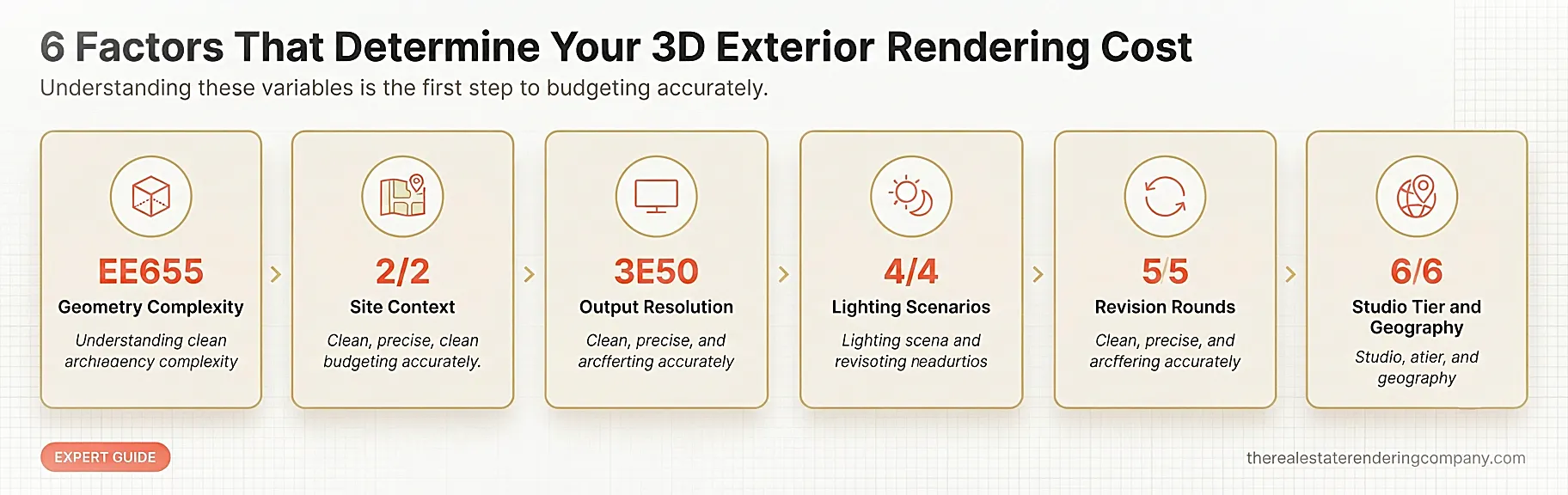
1. Building Geometry Complexity
The most significant cost driver in any rendering engagement is the complexity of the 3D model. A single-story residential cottage with a simple gable roof and standard window grid requires far less modeling time than a 12-story commercial tower with a parametric curtain wall system, projecting sun shades, and a sculpted entry canopy.
Specific complexity factors include:
- Number of unique facade elements (mullions, fins, panels, canopies)
- Roof geometry (flat, gable, hip, complex green roof assembly)
- Site topography (flat grade vs. multi-level terracing or sloped site)
- Structural articulation (pilotis, cantilevers, recessed entries, double-height glazing)
- Custom versus standard window and door profiles
2. Surrounding Site Context
A rendering that shows only the subject building against a plain sky is a concept sketch, not a marketing asset. Professional renderings include:
- Surrounding streetscape geometry (adjacent buildings, roads, sidewalks)
- Landscaping: trees, shrubs, ground cover, water features
- Hardscape: parking areas, plazas, pedestrian paths, street furniture
- Sky environment and atmospheric conditions
The amount of site context modeled and rendered directly affects production hours – and therefore cost.
3. Output Resolution and Intended Use
A rendering produced for an Instagram post requires different resolution specifications than one destined for a printed site hoarding at 3 meters wide, a planning submission exhibit, or an investor deck presentation viewed on a 4K display.
Common resolution tiers and their approximate impact on cost:
| Output Use | Minimum Resolution | Cost Impact |
|---|---|---|
| Social media / web portal | 1920 x 1080 (1080p) | Base rate |
| Print brochures and signage | 3840 x 2160 (4K) or 300 DPI print | +15-25% |
| Site hoarding / billboard | 6K-8K or larger | +25-40% |
| Planning submission exhibits | 4K minimum, often annotated | +15-30% |
| Investor deck / presentation | 4K, often multiple color variants | +20-35% |
4. Lighting Scenario and Time of Day
A standard daytime neutral render under overcast lighting is the most cost-efficient output. Additional lighting scenarios add production hours:
- Golden-hour or sunset hero shot: Requires HDR sky calibration, warm directional shadow setup, and extended post-production
- Dusk or twilight render: Requires interior illumination simulation, facade accent lighting, and substantially more render time due to complex global illumination
- Multiple time-of-day variants: Each unique lighting scenario is essentially a separate render pass
Dusk and night renders typically cost 25-40% more than equivalent daytime renders for the same scene.
5. Number of Revision Rounds
Professional studios structure their engagements with defined revision allowances – typically one to two rounds of consolidated feedback. Revisions beyond the included allowance are billed at hourly rates ($50-$150/hour depending on studio tier and geography).
The most common sources of revision-related cost overruns are:
- Underprepared briefs that require material re-specification after the first draft
- Architectural drawing changes mid-production that require model reconstruction
- Requesting multiple simultaneous changes across a large deliverable set without prioritizing
- Requesting changes after the final delivery stage rather than during the designated review round
6. Studio Tier, Geography, and Turnaround Timeline
Rendering pricing varies significantly depending on who produces it and where they are based:
| Provider Type | Typical Rate per Exterior Still | Trade-offs |
|---|---|---|
| Premium US/UK/Australian studio | $1,200-$3,500+ | Highest quality, commercial portfolio depth, IP protection, reliable revision policy |
| Mid-tier professional studio | $700-$1,500 | Good quality, defined workflow, moderate revision accountability |
| Offshore professional studio (Eastern Europe, Southeast Asia) | $400-$900 | Variable quality, can be excellent, longer communication latency |
| Freelance artist (platform-sourced) | $200-$800 | Variable quality and reliability, limited revision guarantees |
| AI-assisted rendering tools | $20-$100/month subscription | Useful for concept studies, not suitable for marketing or planning submissions |
Rush delivery – typically defined as delivery within 48-72 hours – adds 25-50% to standard rates across all provider tiers.
For developers evaluating full project costs, the real estate rendering price list provides a current, transparent breakdown by deliverable type.
Residential 3D Exterior Rendering Cost: Full Breakdown
Residential exterior rendering encompasses a wide range of property types – from single-family homes and townhouses to mid-rise multifamily buildings and luxury custom residences. Each presents a different modeling complexity profile and therefore a different cost range.
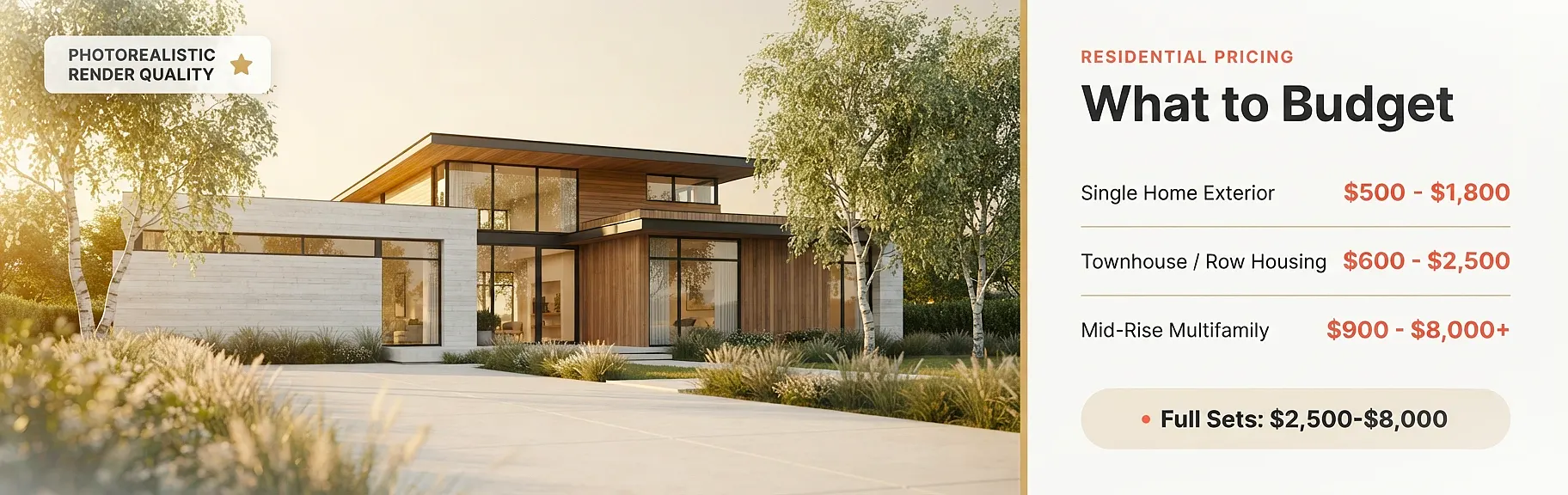
Single-Family Residential Exterior Rendering
The most common residential rendering request: a photorealistic exterior view of a single detached home, typically from a street-level front-facing perspective with landscaping and a sky background.
| Deliverable | Complexity | Price Range (USD) |
|---|---|---|
| Single exterior view, basic context | Low (simple massing, standard materials) | $500-$800 |
| Single exterior view, full landscaping | Medium (detailed materials, mature trees, hardscape) | $800-$1,200 |
| Hero golden-hour or dusk render | Medium-High (atmospheric lighting, full post-production) | $1,000-$1,800 |
| Aerial perspective, site context | High (site modeling, aerial entourage) | $900-$1,500 |
| Full set: 3-4 angles, daytime + dusk | Medium-High (complete deliverable package) | $2,500-$4,500 |
Townhouse and Row Housing Exterior Rendering
Townhouse and row housing developments introduce repetitive unit facades that can be modeled efficiently using parametric techniques, partially offsetting the cost of rendering multiple units in a single scene.
| Deliverable | Price Range (USD) |
|---|---|
| Single unit street-level render | $600-$1,000 |
| Row of 4-6 units, street context | $1,000-$1,800 |
| Full streetscape with landscape and entourage | $1,500-$2,500 |
| Aerial view, full development site | $1,200-$2,200 |
Mid-Rise Multifamily Exterior Rendering
Mid-rise residential buildings (4-12 stories) involve significantly more geometric complexity than single-family homes, particularly when building envelope systems include varied facade treatments, podium-level retail, or rooftop amenity decks.
| Deliverable | Price Range (USD) |
|---|---|
| Street-level hero exterior, standard context | $900-$1,800 |
| Aerial three-quarter perspective | $1,200-$2,200 |
| Dusk/golden-hour hero render | $1,500-$2,800 |
| Full pre-sales deliverable set (4-6 angles) | $4,000-$8,000 |
Proper briefing documentation is essential for multifamily projects. A complete guide on how to prepare home plans for 3D exterior rendering outlines exactly what drawing and specification materials studios need to begin production efficiently.
Commercial 3D Exterior Rendering Cost: Full Breakdown
Commercial exterior rendering covers a broad spectrum of building types – office towers, retail centers, mixed-use podiums, hospitality buildings, industrial facilities, and healthcare campuses. Each type carries different complexity drivers and therefore different pricing realities.
Office Building Exterior Rendering
Commercial office buildings combine large-scale geometry with technically demanding facade systems – curtain wall grids, sun shading devices, and entrance canopy structures that require precise parametric modeling. Best practices for this project type are covered in detail in the office building 3D exterior rendering best practices guide.
| Deliverable | Complexity | Price Range (USD) |
|---|---|---|
| Street-level hero, basic context | Medium (standard curtain wall, simple site) | $800-$1,500 |
| Street-level hero, full urban context | Medium-High (adjacent buildings, streetscape) | $1,500-$2,800 |
| Aerial three-quarter perspective | High (full site context, aerial entourage) | $1,500-$3,000 |
| Dusk/golden-hour hero render | High (interior lighting, atmospheric sky) | $2,000-$4,000 |
| Full deliverable set (4-6 angles) | Complex commercial | $6,000-$12,000+ |
Retail and Mixed-Use Development Rendering
Retail and mixed-use buildings add signage systems, canopy structures, ground-level activation (cafe seating, retail displays), and pedestrian-scale human entourage that increases scene complexity significantly.
| Deliverable | Price Range (USD) |
|---|---|
| Retail frontage, street-level view | $900-$1,800 |
| Mixed-use podium with residential tower | $1,500-$3,500 |
| Large-format retail or lifestyle center | $2,000-$5,000 |
| Full site aerial perspective | $2,000-$4,500 |
Hospitality and Hotel Exterior Rendering
Hotel and resort renderings typically require high levels of atmospheric post-production to communicate the brand experience – warm lighting, lush landscaping, pool terrace context, and carefully art-directed human entourage.
| Deliverable | Price Range (USD) |
|---|---|
| Hotel facade, street-level or driveway approach | $1,200-$2,500 |
| Resort aerial perspective with pool and landscape | $2,000-$5,000 |
| Night render with facade illumination | $2,500-$5,500 |
Industrial and Logistics Facility Rendering
While industrial buildings are geometrically simpler than commercial office structures, large-format facilities require extensive site context modeling – truck courts, car parks, landscape screening, and access road networks.
| Deliverable | Price Range (USD) |
|---|---|
| Single elevation, standard context | $600-$1,200 |
| Aerial site perspective, full logistics context | $1,200-$2,500 |
Residential vs. Commercial 3D Exterior Rendering Cost: Head-to-Head Comparison
| Factor | Residential Exterior | Commercial Exterior |
|---|---|---|
| Typical price per hero still | $500-$1,800 | $800-$4,000+ |
| Modeling complexity | Low to Medium | Medium to Very High |
| Site context required | Moderate (street, yard, landscaping) | Extensive (urban context, parking, multiple site zones) |
| Facade system complexity | Standard (windows, doors, cladding) | High (curtain wall, sun shading, complex canopies) |
| Typical deliverable set cost | $2,500-$6,000 | $6,000-$15,000+ |
| Primary use case | Pre-sales, online listings, planning | Investor decks, pre-leasing, planning, equity raises |
| Rush delivery premium | 25-40% | 30-50% |
| Revision frequency | Low to Moderate | Moderate to High |
| Recommended provider tier | Mid-tier to premium studio | Premium studio preferred |
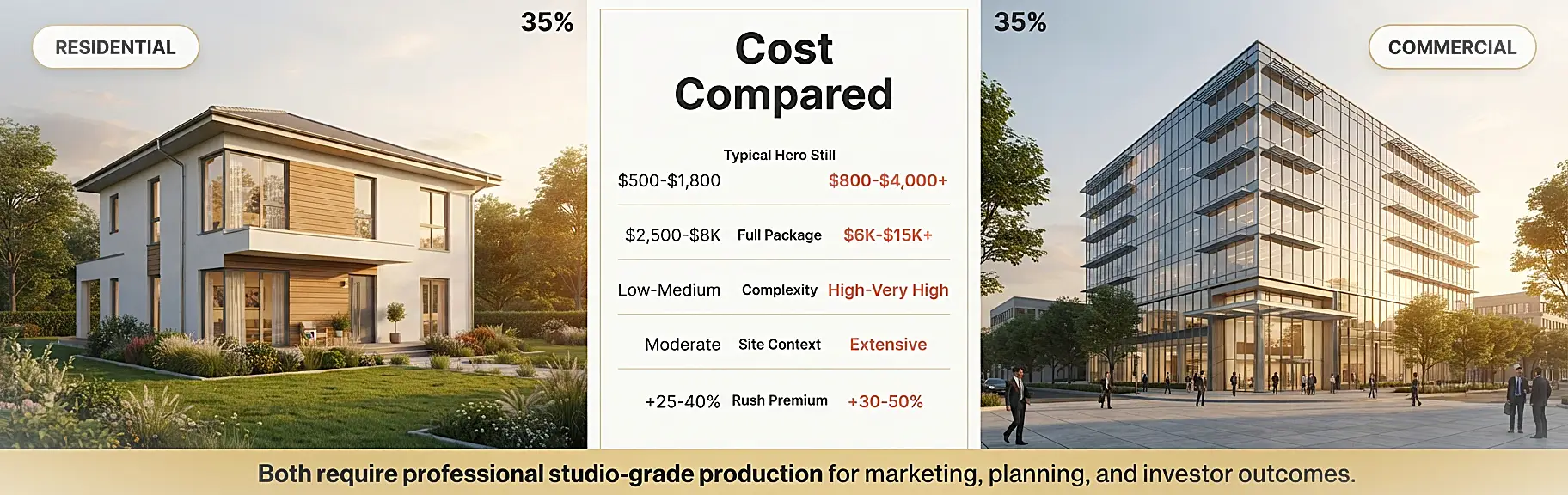
The data shows a clear pattern: commercial exterior renderings cost more because they require more. More modeling hours, more complex material specification, more site context, and more stakeholder review cycles. Understanding why real estate developers use rendering services at these investment levels makes sense when the renders support equity raises, planning approvals, and pre-leasing campaigns where the cost of failure far exceeds the rendering fee.
Additional Deliverable Types and Their Cost Impact
Most development marketing programs require more than a single exterior still. Understanding the full deliverable landscape helps developers budget comprehensively.
| Deliverable Type | Typical Price Range (USD) | Primary Use Case |
|---|---|---|
| Single exterior still (residential) | $500-$1,800 | Online listing, print marketing |
| Single exterior still (commercial) | $800-$4,000 | Planning, investor deck, pre-leasing |
| Aerial perspective render | $900-$3,000 | Site context, investor presentations |
| Interior render (per room/view) | $400-$1,500 | Pre-sales, show suite marketing |
| 3D floor plan render (per level) | $299-$800 | Online listings, sales collateral |
| 360-degree panorama | $800-$2,000 | Virtual tour base, website embedding |
| Animated walkthrough (30-60 sec) | $3,000-$12,000+ | Investor presentations, launch events |
| Full pre-construction package | $8,000-$25,000+ | Complete pre-sales campaign launch |
For detailed current pricing across all these deliverable types, the real estate rendering price list provides a comprehensive and transparent market-rate reference.
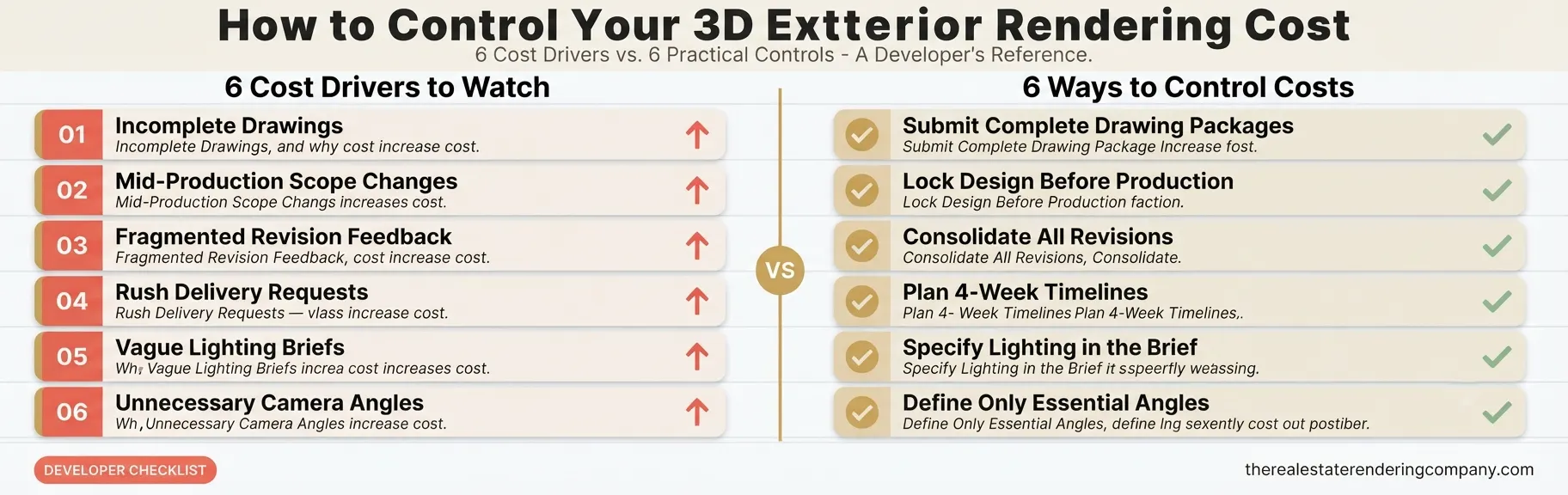
6 Key Factors That Increase Your 3D Exterior Rendering Cost (and How to Control Them)
Understanding the cost levers gives developers practical tools to manage rendering budgets without sacrificing output quality.
Factor 1: Incomplete Drawing Packages
The single most common source of unexpected cost overruns is submitting an incomplete or poorly organized drawing package to the rendering studio. When studios lack confirmed material specifications, accurate site plans, or clear elevation drawings, they either guess (resulting in expensive revision rounds) or pause production to request missing information (extending the timeline).
Control it: Submit complete architectural drawings, confirmed material specifications with manufacturer references, a site plan with north orientation, and visual mood references before briefing the studio.
Factor 2: Scope Changes After Production Starts
Changing the building’s facade material, modifying the roof form, or shifting the approved camera angle after the 3D model is complete requires hours of rework that typically fall outside the original quote.
Control it: Finalize design decisions before commissioning rendering. Use early-stage concept renders during schematic design to lock design direction before investing in full photorealistic production.
Factor 3: Excessive Revision Rounds
Most professional studios include one to two consolidated revision rounds within their base fee. Clients who provide fragmented, incremental feedback – requesting changes one item at a time over multiple email threads – burn through revision allowances rapidly.
Control it: Consolidate all feedback into a single, prioritized list per revision round. Review the first draft with all relevant stakeholders before responding to the studio.
Factor 4: Rush Delivery Requests
Requesting delivery within 48-72 hours requires the studio to restructure their production schedule, often involving overtime or priority queue placement. This premium is unavoidable if the timeline is genuinely urgent, but it is avoidable with proper project planning.
Control it: Build a two-to-four-week production buffer into every rendering brief. Commission renders at design development milestones, not at the last moment before a presentation.
Factor 5: Underspecified Lighting Requirements
A brief that reads “standard daytime render” is easy to produce. A brief that requests “a warm, late-afternoon golden-hour render with soft haze, a dramatic sky, and dusk-lit lobby visible through the ground-floor glazing” is a substantially different production scope – and should be priced accordingly.
Control it: Be specific about lighting requirements in the brief. If you need multiple time-of-day variants, request them upfront as a package rather than commissioning them sequentially.
Factor 6: Requesting Unnecessary Camera Angles
More angles do not automatically produce more marketing value. A focused set of four to six high-quality renders aligned to specific use cases outperforms a set of twelve mediocre ones produced under time and budget pressure.
Control it: Define the use case for each camera angle before commissioning. Remove angles that duplicate information or serve no specific marketing, planning, or investor communication purpose.
How to Evaluate a 3D Exterior Rendering Quote
When a developer receives a rendering quote, these are the questions worth asking before signing off:
- What is included in the base fee? Confirm the number of views, resolution specifications, revision rounds, and file format deliverables explicitly.
- What triggers additional charges? Understand the studio’s policy on scope changes, additional revision rounds, and rush requests.
- How are revisions structured? Are revisions included per image or per project? Is there a maximum number of changes per round?
- What happens if the drawing package changes? Confirm whether architectural changes after modeling starts are billable and at what rate.
- What is the delivery timeline? Confirm both the first draft and final delivery dates, and whether rush delivery is available if needed.
- Who retains the rights to the final deliverables? Confirm that the fee includes full commercial usage rights across all marketing channels.
- Does the portfolio demonstrate experience with this building type? A studio with a strong residential portfolio may not be the right choice for a complex commercial tower – and vice versa.
Common Budgeting Mistakes Developers Make with Rendering
These are the pricing and budget errors that experienced developers learn to avoid.
Mistake 1: Treating Rendering as a Commodity Purchase
The cheapest quote is almost never the best value for development marketing. A render used in a $20 million equity raise, a municipal planning submission, or a flagship pre-leasing campaign is load-bearing marketing infrastructure. A failed or low-quality render in that context costs multiples of what a premium studio would have charged.
Mistake 2: Commissioning Only One Image
A single exterior render – however high quality – limits the marketing program’s versatility. Different channels require different camera angles and compositions. A street-level pedestrian view works for online listings; an aerial three-quarter perspective works for investor decks; a dusk hero shot works for launch campaign assets. Commissioning a structured deliverable set from the outset is more cost-efficient than re-engaging the studio for additional angles after initial delivery.
Mistake 3: Not Budgeting for Revision Rounds Upfront
Most projects require at least one meaningful revision round after the first draft. Developers who budget only for the base production fee consistently experience invoice surprises when revision charges are applied.
Mistake 4: Conflating Rendering Cost with Modeling Cost
The difference between 3D rendering and 3D modeling is a critical pricing distinction. Modeling builds the geometry; rendering produces the final image. For complex commercial projects, modeling can represent 50-60% of the total production fee. Studios that quote very low rendering fees may be underquoting on modeling and charging for it separately during production.
Mistake 5: Assuming All Studios Produce the Same Output
Two studios can quote a similar per-image fee and deliver dramatically different quality outputs. Portfolio review and a clear understanding of the studio’s production workflow are essential before committing to a project – especially for commercial-scale deliverables.
Expert Tips: Maximizing ROI on Your Rendering Investment
1. Sequence the rendering brief with the capital stack timeline. Commission your hero exterior and aerial perspective before closing your equity round. Use those images in the investor deck. Reserve the full deliverable set budget for the pre-leasing campaign launch.
2. Negotiate a volume rate for multi-angle packages. Most studios apply a volume discount for deliverable sets of four or more images from the same scene, since shared model setup and lighting amortize across multiple views. A four-view package often costs less than four individually commissioned renders.
3. Request separate sky and color variants as part of the initial brief. Once a scene is fully set up and rendered, producing a daytime variant and a dusk variant of the same camera costs a fraction of commissioning a second independent render. Request these as add-on variants in the original brief rather than as subsequent revision requests.
4. Invest more in the hero image, less in supporting views. The hero exterior render – the one used as the lead image in marketing, the investor deck cover, and the project website banner – justifies the highest production investment. Supporting views (side elevations, close-up details) can be produced at a standard quality tier without compromising the overall marketing impression.
5. Use rendering to stress-test the design before locking specifications. Commissioning a photorealistic exterior render during the design development phase – before specifications are frozen – functions as a paid design review. Material mismatches, scale issues, and facade coordination problems that the render reveals at this stage are inexpensive to fix. The same changes post-construction documentation are costly. This reinforces why selling properties faster with 3D renderings starts with investing in the right assets at the right project stage.
6. Budget for the full deliverable set, not just one image. Research from SolidRender consistently shows developers recoup their rendering investment 10-30 times over through faster pre-sales, smoother approvals, and stronger negotiating positions with contractors and lenders. A single under-budgeted render that fails to serve its purpose produces zero return. A structured deliverable set aligned to specific business outcomes produces measurable results.
What Does a Full Rendering Package Cost for a Development Project?
Rather than thinking per-image, most experienced developers budget for a complete rendering program aligned to their project’s marketing phases. Here is a realistic budget framework by development type:
| Project Type | Rendering Scope | Estimated Budget Range (USD) |
|---|---|---|
| Single custom home | 2-3 exterior stills, 1 aerial | $2,000-$5,000 |
| 10-20 unit townhouse development | 3-4 exteriors, 1-2 floor plans | $3,500-$7,500 |
| 50-100 unit mid-rise residential | 4-6 exteriors, 2-3 interiors, floor plans | $8,000-$20,000 |
| Small commercial office (3-5 floors) | 3-4 exteriors, lobby render | $5,000-$12,000 |
| Large commercial office (10+ floors) | 5-6 exteriors, lobby, amenity, floor plans | $12,000-$30,000+ |
| Mixed-use development | 6-8 exteriors, 3-4 interiors, floor plans, animation | $20,000-$60,000+ |
| Hospitality / hotel development | 4-6 exteriors, 3-5 interiors, pool/terrace views | $15,000-$40,000+ |
These ranges represent mid-tier to premium professional studio pricing with full commercial usage rights, defined revision allowances, and market-ready output quality. According to industry pricing data from ArchiCGI and NoTriangle Studio, these ranges reflect current 2026 market standards for architectural visualization in active real estate development contexts.
Frequently Asked Questions: 3D Exterior Rendering Cost
How much does a 3D exterior rendering cost on average?
The average 3D exterior rendering cost ranges from $500 to $1,500 per image for residential projects and $800 to $4,000 or more for commercial buildings. Factors including building complexity, site context, resolution requirements, lighting scenarios, and studio tier all affect the final price. Most professional full-service rendering packages for development projects range from $3,500 to $15,000 or more depending on deliverable scope.
Why does commercial 3D exterior rendering cost more than residential?
Commercial exterior renderings cost more because they involve greater geometric complexity (curtain wall systems, sun shading devices, complex canopies), larger site context models (urban streetscapes, structured parking, multi-zone landscapes), higher resolution requirements for planning and investor submissions, and longer revision cycles due to more stakeholders. The production hours required to model and render a 12-story office tower are substantially greater than those for a single-family home.
What is included in a typical 3D exterior rendering fee?
A standard professional rendering fee typically includes: 3D modeling from provided drawings, material and texture assignment, lighting setup for the specified time of day, one to two rounds of revision, post-production, and delivery of high-resolution final files with commercial usage rights. Rush delivery, additional revision rounds, and extra camera angles are usually billed separately.
How can I reduce my 3D exterior rendering cost without sacrificing quality?
The most effective ways to reduce cost without compromising output quality are: submit a complete, well-organized drawing package with confirmed material specifications; define all deliverables upfront rather than commissioning them incrementally; consolidate feedback into a single, prioritized revision round; negotiate a volume rate for multi-angle packages; and avoid rush delivery requests by building a four-week production buffer into your project timeline.
Does 3D exterior rendering cost more for dusk or night renders?
Yes. Dusk, twilight, and night renders typically cost 25-40% more than equivalent daytime renders for the same scene. This premium reflects the additional production complexity involved: interior luminaire simulation, facade accent lighting, complex global illumination settings, and extended post-production required to balance artificial light sources with atmospheric sky conditions.
What is a realistic 3D rendering budget for a 50-unit residential development?
A professionally executed rendering program for a 50-unit mid-rise residential development typically requires: 4-6 exterior stills, 2-3 interior renders of representative unit types, and 3D floor plan renders for each unit type. A realistic total budget for this scope ranges from $8,000 to $20,000 with a mid-tier to premium professional studio, depending on building complexity and the number of unique deliverables required.
Is it worth paying more for a premium rendering studio?
For development projects where renders will be used in equity raises, planning submissions, pre-leasing campaigns, or high-visibility public marketing, the answer is consistently yes. A render used in a $10 million capital raise or a flagship pre-leasing campaign is load-bearing business infrastructure. The quality difference between a premium studio and a budget platform is visible to investors, planning boards, and prospective tenants – and that difference directly affects outcomes.
How long does a 3D exterior rendering take to produce?
Standard turnaround for a professional exterior render ranges from 5-10 business days for residential projects and 7-14 business days for complex commercial buildings. Rush delivery (48-72 hours) is available from most studios at a 25-50% premium. Full deliverable packages for large developments may take 3-6 weeks to complete, depending on scope and revision cycles.
Budget for 3D Exterior Rendering Cost as a Business Investment, Not a Line Item
The 3D exterior rendering cost question is ultimately the wrong frame for how serious developers should approach visualization budgeting. The right frame is: what does a failed equity raise cost? What does a stalled planning approval cost? What does a pre-leasing campaign that generates no qualified leads cost?
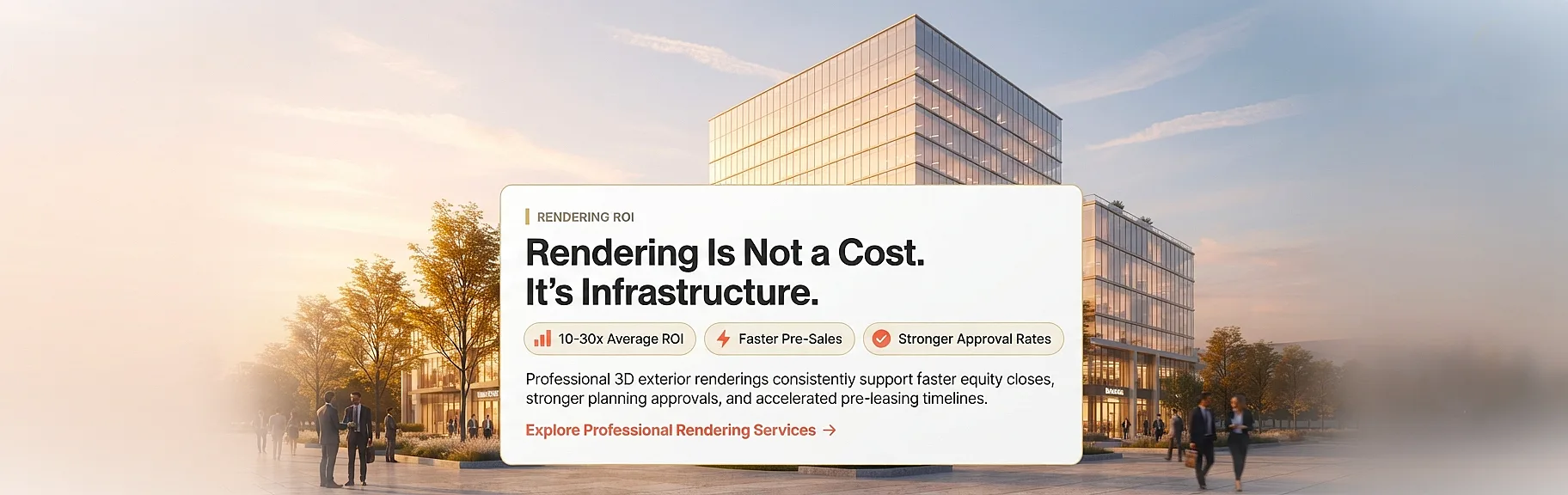
Compared to those outcomes, the investment in professional-grade exterior rendering – residential or commercial – is consistently one of the highest-returning line items in a development marketing budget. The condition is that you invest strategically: commission the right deliverables at the right stage, brief the studio completely, and work with a team that has proven experience with your specific building type.
Whether you are marketing a luxury custom home, a 200-unit multifamily development, or a class-A commercial office tower, the pricing frameworks in this guide provide the benchmarks needed to evaluate quotes confidently, avoid budget surprises, and set realistic expectations for every stakeholder involved.
Ready to commission market-grade exterior visualizations that directly support your development’s sales and approval timelines? Get professional real estate 3D exterior rendering services built to deliver investment-grade results – on time, on brief, and aligned to your project’s business outcomes.